



 ADVICE COLUMN · 2026
My 10-Year-Old Is Well Below Grade Level. What Should I Do?
 Column by Aria
JULY 2026
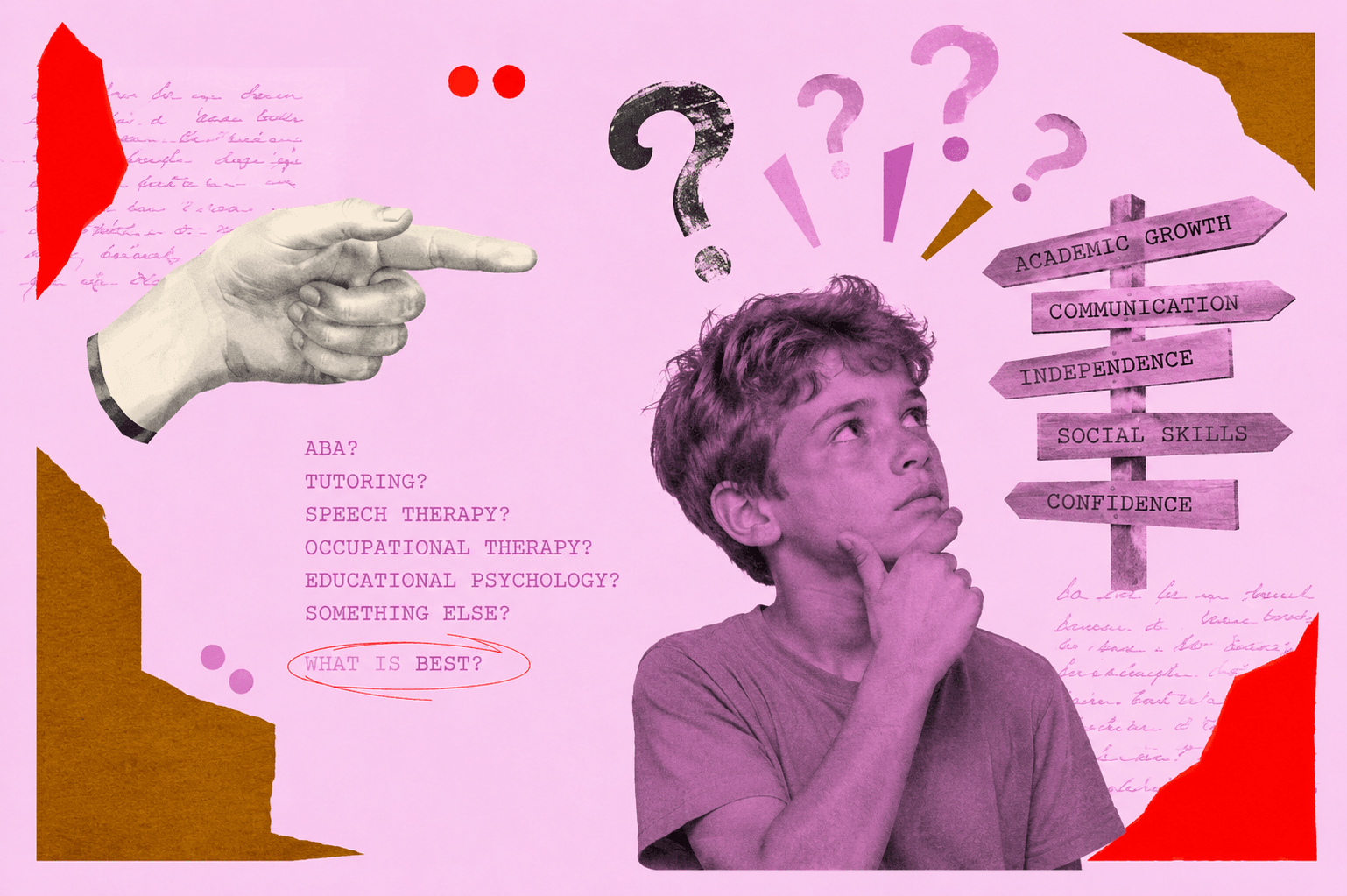
A letter from a family
Dear Aria:
My son is 10 years old and currently in fourth grade. He spends part of his day in general education and part in special education. He has very limited speech and communicates very little, but I know he understands much more than people give him credit for. I keep hoping there is something we have not tried yet that could help him catch up academically so he can be more successful in school and eventually learn what other fourth graders are learning. Would ABA, educational psychology, tutoring, or another therapy help him reach grade level more quickly? I sometimes wonder if we are missing something that could finally help him make that breakthrough.Aria responds
Many parents understandably hope there may be one therapy, educational program, medication or teaching approach that has not yet been tried—something that could finally help their child make a major breakthrough and catch up academically. That hope comes from a place of love, determination, and a desire to give a child every possible opportunity to succeed. It is also understandable to feel that a child may know much more than he can currently express, particularly when he has very limited speech.
ABA therapy, educational psychology, speech therapy, occupational therapy, specialized academic instruction, and tutoring may all be helpful, but they serve different purposes. A comprehensive assessment of the child's developmental, cognitive, communication, adaptive and academic functioning is typically necessary to determine the learner's current level of performance, patterns of relative strengths and weaknesses, barriers to learning and the prerequisite skills required for subsequent instruction.
Applied behavior analysis may be used to design individualized, data-based interventions targeting functional communication, receptive and expressive language, pragmatic communication, instructional control, adaptive behavior, social participation, academic readiness and specific academic skills. Depending on the learner’s needs, intervention may also incorporate strategies to support psychological flexibility, emotional regulation, tolerance of distress, values-guided behavior and coping with difficult internal experiences. Additional areas may include executive functioning skills such as planning, organization, task initiation, sustained attention, cognitive flexibility, inhibition, working memory, problem-solving and completion of multistep activities. Support for friendships and social relationships may also include developing conversational reciprocity, initiating and maintaining interactions, perspective-taking, selecting and maintaining healthy friendships, choosing appropriate friends, planning and participating in social activities, handling teasing or bullying, resolving disagreements and navigating peer conflict, problem-solving in social situations and developing meaningful participation and peer relationships within school, family and community environments.
Speech-language therapy may be particularly indicated for concerns involving speech-sound production, articulation, phonological disorders, childhood apraxia of speech, dysarthria, fluency disorders such as stuttering, voice and resonance disorders, oral-motor functioning, feeding or swallowing difficulties, and other communication difficulties requiring specialized speech-language pathology assessment.
Occupational therapy may address sensory-motor functioning, fine-motor development, self-care, visual-motor integration and access-related barriers that interfere with classroom participation.
Specialized academic instruction focuses on explicit, sequenced teaching aligned with the student’s present levels of performance and individualized educational needs. Tutoring may be beneficial for reinforcing previously introduced content; however, conventional grade-level tutoring is unlikely to produce substantial progress when foundational or earlier grade level language, literacy, numeracy, attention, or learning-readiness skills have not yet been established. In such cases, instruction should begin at the learner’s current instructional level and systematically progress toward more advanced academic objectives. Tutoring can reinforce academic instruction, but traditional fourth-grade tutoring alone is unlikely to be effective if the child has not yet acquired the earlier skills upon which fourth-grade work depends.
Read The Science Behind This Answer
The guidance provided here is supported by two complementary areas of research. The first research section explains where instruction should begin and why prerequisite skills matter. The first explains why instruction should begin with the learner’s present developmental and academic profile rather than chronological age or grade placement alone. The second explains what cognitive and emotional conditions allow a child to benefit from that instruction. The second explains why academic progress depends not only on direct instruction, but also on executive functioning, emotional well-being, engagement, social connection and the quality of the learning environment. Together, they provide the scientific rationale for assessing the whole learner, beginning at the correct instructional level and building progress systematically rather than relying on grade placement, service labels or the promise of a rapid breakthrough.
The recommendations here are not based on the assumption that one therapy can quickly cause a child to “catch up”. They are informed by research showing that academic progress develops through the interaction of communication, cognition, executive functioning, self-regulation, social-emotional development, engagement and appropriately sequenced instruction. The evidence also emphasizes that children learn best when educational expectations are ambitious but aligned with their present abilities, and when the learning environment supports emotional safety, social connection, physical well-being and meaningful participation.
The guidance here is informed by research in developmental psychology, educational psychology, executive functioning, communication, and learning science. The sections below explain several scientific principles that are particularly relevant when determining how to support an older child whose communication and academic skills are developing at different rates.
Choose a topic
At the same time, child development is usually a gradual process. Skills tend to build upon earlier prerequisite skills rather than appearing all at once. One of the most important principles in child development is that teaching must begin from the child’s current developmental and learning profile—not simply from his chronological age or assigned grade. If a child is currently demonstrating foundational communication skills similar to those seen in very early language development, therapy may first focus on helping them build those early communication abilities before expecting more advanced language, reading, writing, or classroom skills. Similarly, if academic assessment shows that a child is currently learning many kindergarten-level concepts, instruction often needs to begin there before progressively building toward first grade, second grade, and beyond.
A child may be 9 or 10 years old and enrolled in fourth grade while still needing instruction in kindergarten-level literacy, mathematics, classroom participation, self-care or learning-readiness skills. In that situation, intervention would generally need to begin with those kindergarten-level skills and then build progressively toward first-grade, second-grade, third-grade and eventually age-level expectations. Catching up across several years of missed or unmastered prerequisite skills can take considerable time.
When a child is nonverbal or has very limited functional communication, This does not mean that the child functions like a 2- or 3-year-old in every domain or that he lacks intelligence. Rather, it indicates that certain communication repertoires may not yet be consistently established.
Communication may require an even earlier starting point. When a child is nonverbal or has very limited functional communication, assessment may indicate that instruction should initially focus on skills commonly developing during the toddler and early preschool years, approximately between 2 and 3 years of age. This does not mean that the child functions like a 2- or 3-year-old in every domain or that he lacks intelligence. Rather, it indicates that certain communication repertoires may not yet be consistently established. These foundational skills may include using words to request desired items and activities; labeling familiar people, objects, and actions; answering simple questions; following one- and two-step directions; imitating words and short phrases; combining words into short phrases; gaining another person’s attention; participating in short reciprocal interactions; making simple choices; and communicating refusal, discomfort, assistance needs or basic emotions. Intervention may also address responding to one’s name, attending to a communication partner, engaging in joint attention, taking turns and using language across different people and environments. These skills may need to be taught explicitly before more advanced conversational, academic and social-language skills can develop.
Many communication programs therefore begin by strengthening functional requesting, early expressive vocabulary, comprehension of common words and directions, phrase development, imitation, joint attention, reciprocal interaction and spontaneous communication before expecting more advanced skills such as sustained conversation, narrative language, reading comprehension, written expression, complex perspective-taking or participation in grade-level classroom discussions.
Similarly, if academic assessment indicates that he is working primarily within the kindergarten-to-first-grade range, instruction may begin with blending and segmenting sounds, decoding simple words, recognizing common sight words, reading short sentences, answering basic questions about a text, writing simple words and sentences, understanding place value, comparing quantities and completing basic addition and subtraction problems. Instruction may also address following multistep classroom directions, sustaining attention during structured lessons, completing short assignments and increasing independence with academic routines.
Once these skills become more consistent and independent, instruction can gradually move toward increasingly complex material. Academic learning is cumulative and sequential . Just as multiplication cannot be meaningfully taught without an understanding of number relationships, addition, and subtraction, fourth-grade reading comprehension cannot be fully accessed without foundational decoding, vocabulary, language comprehension, attention and communication skills.
Beginning at an earlier instructional level does not mean giving up on higher expectations. Quite the opposite. Children deserve ambitious long-term goals and people who genuinely believe in their potential. However, high expectations should be paired with instruction at the right starting point. Expecting a child to perform fourth-grade work without teaching the prerequisite skills may result in repeated failure, prompting, frustration, withdrawal or dependence on adults. Teaching the next attainable step allows the child to experience genuine success and creates a stronger foundation for future learning.
This is also why it is so important to seek help as soon as developmental, communication or academic concerns are identified. It is one of the reasons early identification and early intervention are so important. Early intervention is especially helpful because it allows foundational skills to be taught before the gap between the child’s abilities and the demands of school becomes larger.
As children grow older, academic expectations, language demands, social expectations, executive functioning and independence continue increasing every year. If foundational developmental skills have not yet been established, the gap between what the child currently knows and what the environment expects may continue to widen over time. Beginning intervention as early as concerns are recognized provides children with more opportunities to build these foundational skills alongside their peers before educational and daily-life demands become increasingly complex.
When support is delayed, the child does not simply remain in the same place while peers move forward; the gap between the child's current developmental level and age-related expectations may gradually widen, and he may have an increasing number of prerequisite skills that need to be mastered before more advanced learning can occur. Delays in accessing intervention can arise for many reasons, including lengthy waitlists, uncertainty about the next steps, conflicting recommendations, financial or insurance barriers, limited service availability, difficulty accepting what a child may need or the understandable hope that a child may develop these skills with time. Regardless of the reason, once developmental or learning concerns are recognized and identified, beginning appropriate support promptly is generally more helpful than continuing to wait for the child to catch up independently. Initiating appropriate intervention as early as possible provides the greatest opportunity to support continued developmental and academic progress.
The encouraging news is that development does not stop simply because a child gets older. Children, adolescents and even adults continue learning throughout life. The goal is not to compare a child to everyone else or to become discouraged by how much catching up remains. The goal is to identify where the child is today, begin from that point, continue building meaningful skills step by step and never stop believing that growth remains possible. The most important step is not finding a quick fix—it is beginning from the right starting point and continuing to move forward.
A child’s school placement should not be judged only by the percentage of time he spends in general education. The more important question is whether he can meaningfully access instruction, communicate with teachers and classmates, participate in classroom routines, build relationships, remain emotionally safe, make measurable progress, and receive the level of support needed to learn successfully. Inclusion can be valuable, but simply placing a child in a classroom designed for students working at a very different developmental and academic level does not automatically create meaningful inclusion. Being physically present in a general education classroom is not the same as being meaningfully included. If the curriculum, language demands, pace, and level of independence are far above the child’s current abilities, he may spend much of the day unable to understand the lesson, communicate what he knows, participate with peers, or complete work without extensive adult assistance.
Over time, unsupported placement in a classroom that does not match the child’s needs can contribute to isolation, repeated failure, frustration, emotional distress, behavioral dysregulation, dependence on adults, or increased vulnerability to exclusion and bullying. At the same time, a specialized classroom should not be selected merely because a child has limited speech or a disability. The goal is not to move him into the least specialized setting as quickly as possible, nor to assume that a more restrictive setting is automatically better. The goal is to identify the environment in which he can be appropriately challenged, actively taught, emotionally supported, connected with peers and meaningfully progressing from his current communication, academic, social and adaptive level. It is also helpful to clearly determine what he can currently do independently, what he can do with support, which skills should be taught next and how progress will be measured over time.
If a child currently receives part of his education in a specialized setting , it is also important to look beyond the general education versus special education label and examine the actual quality of the instruction and support provided there, safety, expectations and instructional practices within that program. Special education can offer individualized teaching, communication supports and a more appropriate pace of learning, but programs vary considerably in their expectations, instructional practices, safeguards and opportunities for student participation. Its benefits depend on whether the child is being taught meaningful skills, appropriately challenged, protected from harmful practices and given genuine opportunities to communicate, participate and progress. Families may therefore need to look closely at whether the child is being meaningfully taught, appropriately challenged, emotionally and physically safe and making measurable progress rather than assuming that a specialized placement is effective simply because it is labeled special education. This is particularly important because the quality of special education services can vary considerably across schools, districts, classrooms, and individual staff teams.
“Special education is not the same everywhere”
Many parents understandably worry about whether their child is receiving enough challenge, sufficient support, and an educational experience that is genuinely helping them grow. Those concerns are valid.
Many special education teachers and support staff are deeply committed professionals who work hard to help students succeed, provide individualized instruction, communication supports and meaningful opportunities for progress. However, like any educational system, there are also programs in which expectations may be too low, academic instruction may be limited, or students may not receive the level of safety, support and educational challenge they require.
For example, federal investigations have identified school districts in which students with disabilities were subjected to inappropriate restraint and seclusion practices instead of receiving positive behavioral supports. In 2026, the U.S. Department of Justice concluded that the Special School District of St. Louis violated the rights of students with disabilities by routinely using unjustified restraint and ineffective seclusion practices rather than providing appropriate interventions and supports. During the period investigated, hundreds of students experienced thousands of episodes of seclusion and hundreds of restraint incidents.
These findings are concerning, but they should not be interpreted as representing all special education programs. Rather, they highlight why families should remain actively involved in their child's education, ask questions, observe progress and advocate when services are not meeting their child's needs.
Research also suggests another important consideration. Sometimes students with significant disabilities are not consistently provided access to appropriately ambitious academic instruction. Expectations may unintentionally become focused primarily on behavior management, compliance or daily routines while academic learning receives less emphasis than it should. Every child deserves instruction that is individualized, appropriately scaffolded and based on high expectations, even if the curriculum must be adapted or taught at an earlier developmental level. Children should not be expected to learn beyond their current developmental readiness, but neither should assumptions be made that they are incapable of continued academic growth.
Parents should also remember that they have educational choices. Depending on state laws, the child's needs, available resources and family circumstances, some families find that homeschooling or accredited online schooling provides an environment that is better able to meet their child's individual pace of learning. These options may allow greater flexibility, reduced sensory demands, individualized instruction and closer integration of therapies throughout the day. For some children—particularly those experiencing severe anxiety, bullying, medical needs or repeated school-related distress—these settings can provide a more supportive learning environment.
At the same time, homeschooling and online education are not the best fit for every family. They require substantial caregiver involvement, planning, consistency and opportunities for social interaction and community participation. Some children thrive in public schools with appropriate supports, while others benefit from specialized schools, private programs or home-based education. There is no single educational setting that is right for every child.
Ultimately, the question is not whether a child is educated in general education, special education, online school, or at home. The more important question is whether the child is learning new skills, communicating more effectively, developing meaningful relationships, feeling emotionally safe, and making measurable progress toward greater independence every 3-6 months. Those outcomes—not the name of the educational setting—are the best indicators that a child is receiving an education that truly meets their needs.
Ty's, yours. Take care.
- Aria
This column offers general, educational guidance. It is not individualized medical, psychological, diagnostic, educational, or legal advice.
Have your own question? Submit a letter to Ask Aria.